Private 5G Could Hit $84.7B as AI Moves to the Edge
$84.7 billion in private LTE and 5G network spending by 2031, up from $17.3 billion this year. I read that as a forecast of something other than revenue. It is a forecast of how many things will be connected, and of how different those things will be from each other.
AI is what changed the slope. It is the force driving the spending, and it does not arrive as software on equipment that is already there. It arrives as cameras, sensors, robotics and inference hardware, each of which has to sit close to the process it is watching, and each of which connects over cellular. If private 5G is becoming the foundation that carries AI workloads, then security has to operate at that same foundation. That is the argument. The rest of this is why it matters now.
The number is really about assets
Reaching $84.7 billion by 2031 is close to 400% growth in five years. Growth like that does not come from more of the same deployments. The research points at where it comes from:
- Automated guided vehicles and autonomous mobile robots
- Machine vision and quality inspection
- Predictive maintenance on production assets
- Industrial control operations
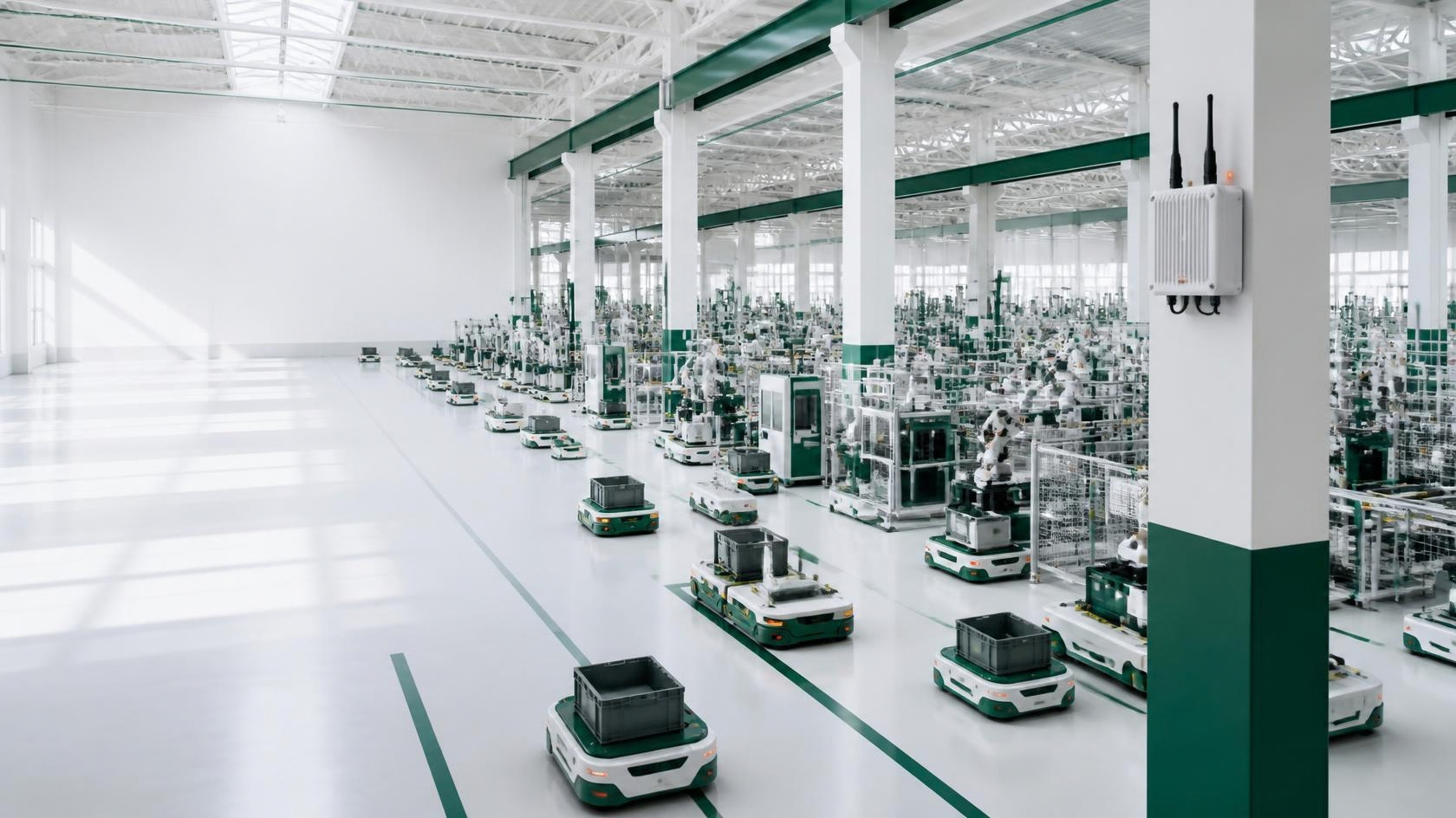
Every one of these puts inference close to the thing being measured. That is the point of running AI at the edge, and it means the asset population on a private network stops being a list anyone can hold in their head. A network scoped for a known set of equipment starts carrying gear specified by a different team, delivered by a different vendor, and commissioned on a different schedule. Each one arrives with a SIM and connects itself.
The question nobody owns
Here is what that looks like on a plant floor or in a substation yard. An OEM technician brings a diagnostic device to service a cobot cell. It connects. Three weeks after the technician has gone, it is still on the network, and nobody has noticed.
The tools watching the rest of the enterprise were built for laptops and servers. The OT platforms watching the plant floor read OT protocols and traffic patterns. Neither sees what is joining at the cellular layer. That gap is structural rather than an oversight. The private cellular network sits in the seam between IT and OT, and both teams own part of it, which in practice means neither team owns the inventory.
So one question gets harder every quarter. What is connected to this network right now, and is it supposed to be? A team that cannot answer it cannot apply proper private cellular segmentation either, because segmentation depends on knowing what you are separating.
Security belongs at the same layer as the workload
Gartner has been describing the same shift. In the Reference Architecture Brief, Private 5G for AI Outcomes, it states that “Private 5G networks offer a connectivity foundation for AI and MLOps including physical AI, distributed inferencing, information technology/operational technology integration and operational efficiency.” In our view that is the market putting language to something our customers already treat as a working assumption. OneLayer was named in two of this year’s Gartner reports on private 5G and AI security, which I take as a signal about the category more than about us. More on both citations in our announcement.
If the foundation carries the workload, the security model has to sit on the foundation. In practice that means three things:
- A continuous inventory of every cellular-connected asset, built from what the asset actually is rather than what the purchase order said it would be
- Zero Trust policy applied per asset and per asset group, enforced at the SIM and network layer rather than on top of the applications those assets run
- Change detection, so a new SIM, a moved asset, or a behavior that differs from yesterday surfaces as an event rather than a discovery months later
None of this asks a security team to become cellular engineers. It asks that cellular-connected assets fall under the same policy as everything else the team is accountable for.
A spending forecast is a statement about demand. It says nothing about whether the thing being bought can be run safely at that size. What I keep coming back to is where AI is actually going. It is moving into physical operations, into the vehicles, the cameras and the machines that do the work. Once that happens the network stops sitting underneath the operation and becomes part of the operation itself. Security has to evolve with it.
Gartner Report, Hype Cycle for Data, Analytics and AI for Enterprise Communication Services, 2026, By Kameron Chao, Nate Novosel, July 2026.
Gartner Insights, Reference Architecture Brief, Private 5G for AI Outcomes, By Mohini Dukes, Sylvain Fabre, July 2026.
Gartner and Hype Cycle are a trademark of Gartner, Inc. and/or its affiliates. Gartner does not endorse any vendor, product or service depicted in its research publications and does not advise technology users to select only those vendors with the highest ratings or other designation. Gartner research publications consist of the opinions of Gartner’s research organization and should not be construed as statements of fact. Gartner disclaims all warranties, expressed or implied, with respect to this research.

OneLayer CEO