OneLayer’s AI combines the deepest private cellular data set in the industry, deep hooks into your enterprise systems, and real cellular and networking expertise, so every team gets answers that make sense, not just cellular experts.
The Problem
More dashboards isn’t more insight. Your team already knows that.

Connectivity issues rarely have a single cause, and they’re rarely just connectivity: performance degradation and cost blowouts from bad roaming behavior show up the same way, as noise across dozens of signal types: RAN behavior, core signaling, user-plane data. Deterministic rules can’t correlate fast enough, so troubleshooting stalls in Tier 3.

3GPP signaling codes, RAN metrics, cellular packet core terminology. Every legacy tool defaults to it. Security teams, device managers, and OT engineers end up translating jargon before they can even start solving the problem.
A device drifting to an unfamiliar IP, moving an unusual volume of data, showing up somewhere it’s never been: none of it fits a fixed threshold. By the time a manual review catches the pattern, the exposure window has already closed.
THE SOLUTION
Built On The Deepest Private Cellular Data
Set There Is
OneLayer extends Zero Trust to private 5G and LTE networks through two coordinated controls: a staged onboarding environment that verifies every device before it reaches production, and device-level microsegmentation that enforces communication boundaries once they do.
DATA FOUNDATION
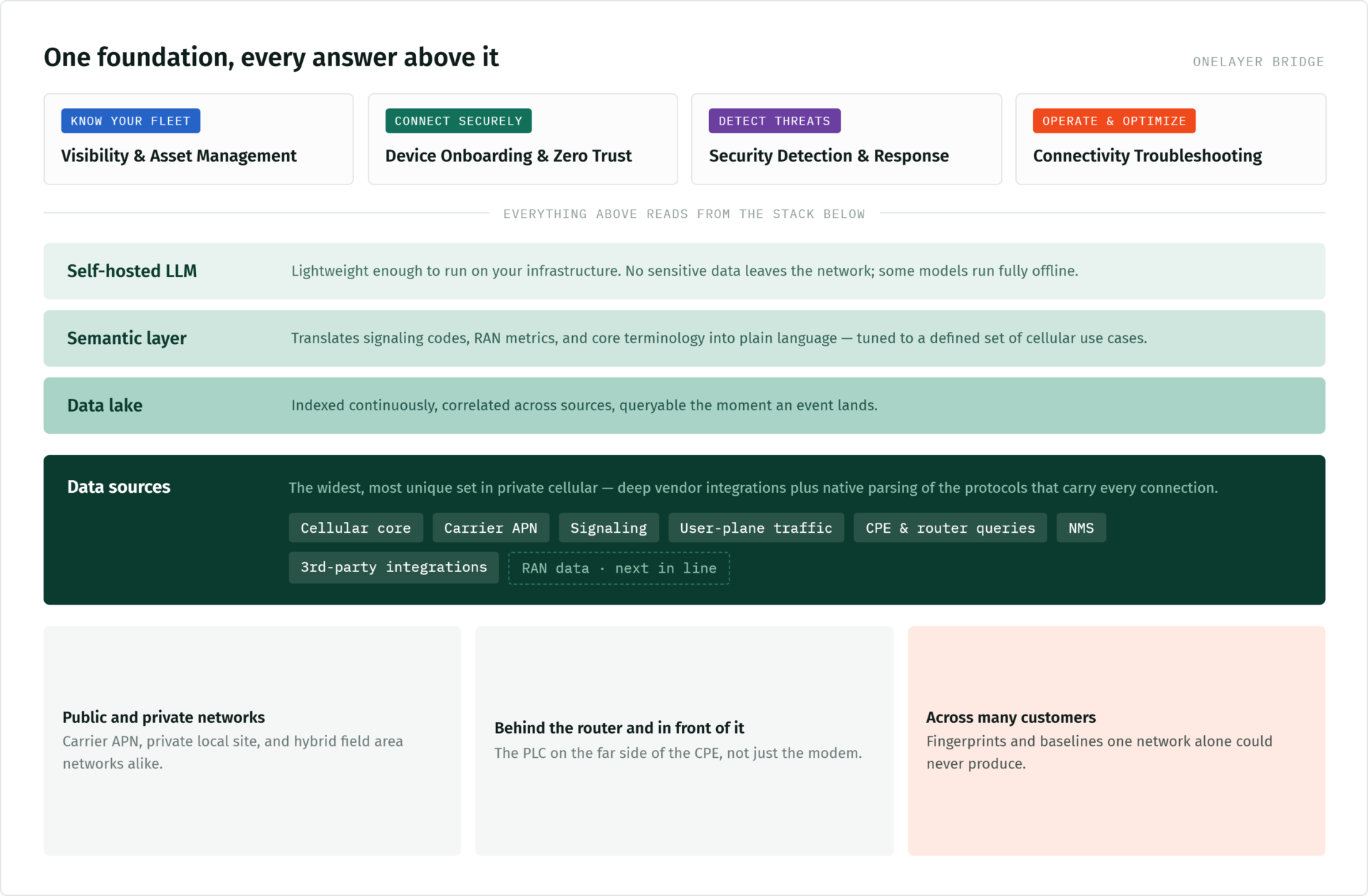
OneLayer’s AI starts with the widest, most unique set of private cellular data sources in the industry: deep integrations with core vendors, cellular routers, network management systems, and other enterprise systems, plus native parsing of the signaling and user-plane protocols that carry every connection. It’s indexed continuously into a dedicated data lake, with RAN data next in line. No other platform sees this many device types, across this many network types, across this many customers, public and private networks alike, behind the router and in front of it.
PLAIN LANGUAGE AI
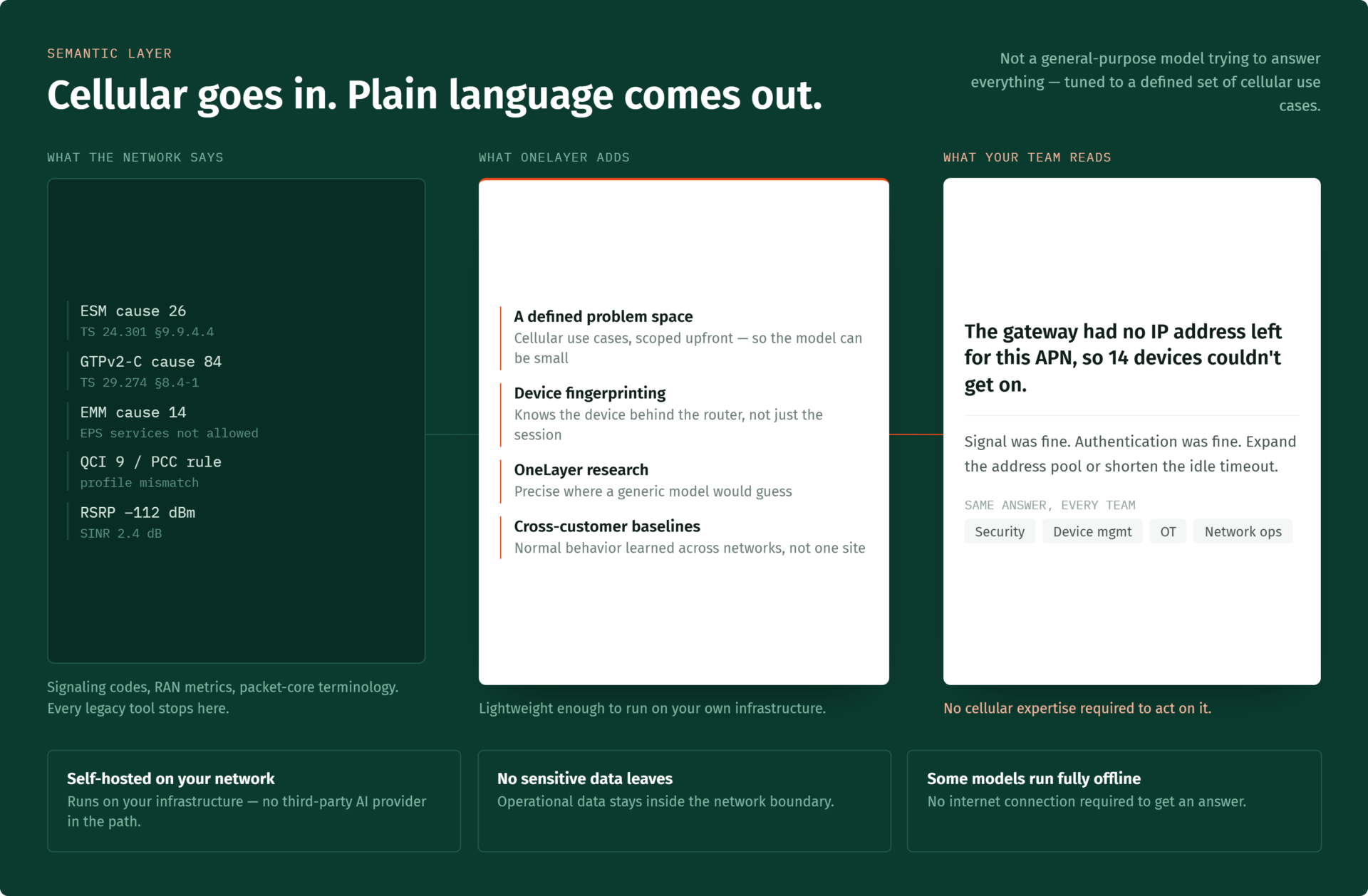
This isn’t a general-purpose model trying to answer everything. It’s tuned to a defined set of cellular use cases and enriched with OneLayer’s own device fingerprinting and research, so it’s precise where a generic model would guess. Because the problem space is defined upfront, the models can be lightweight enough to be self-hosted on your network. No sensitive data has to leave it to get an answer. Some models run fully offline.
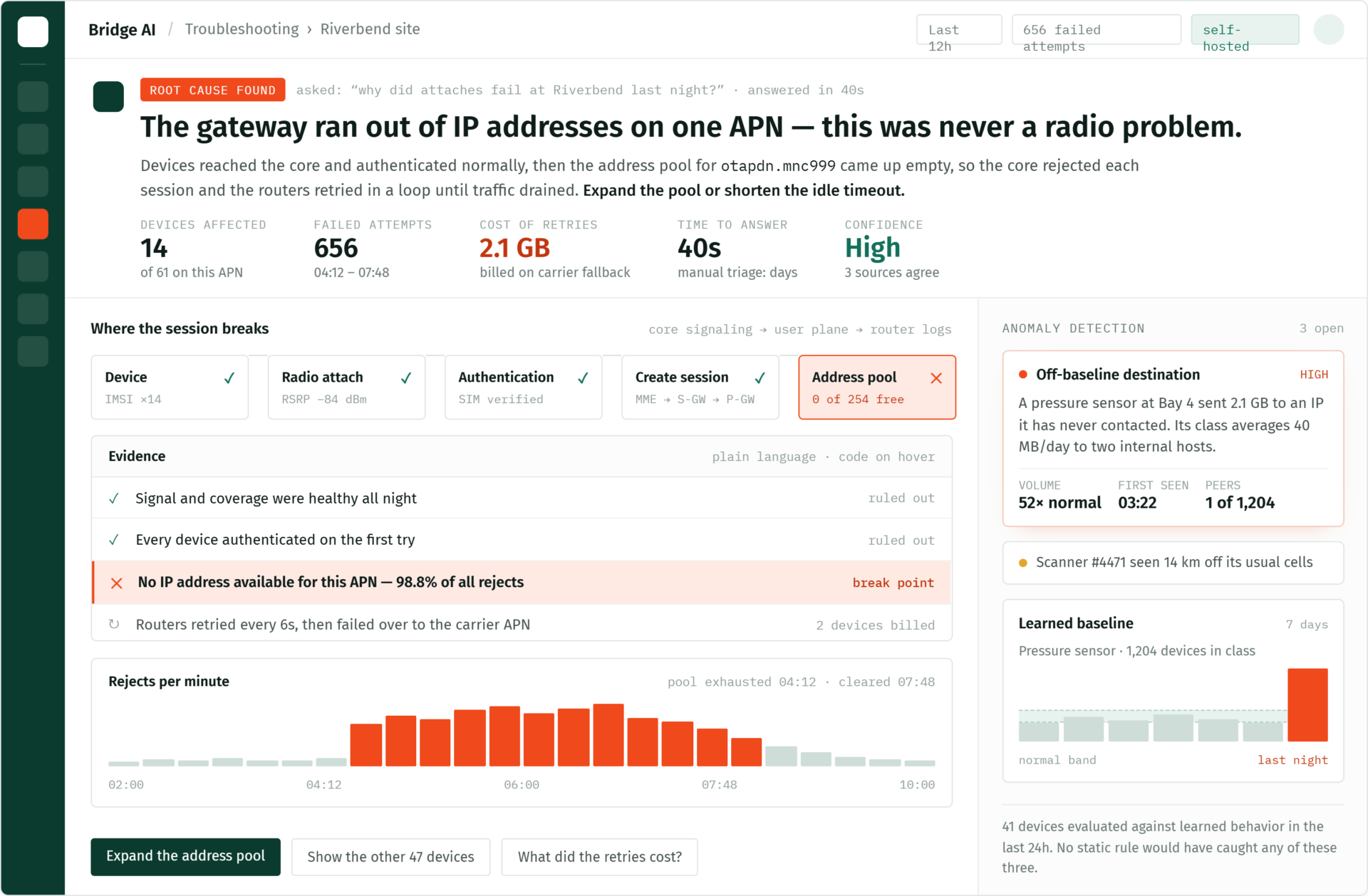
ROOT CAUSE ANALYSIS
This is where AI carries the most weight today. It correlates signals across your network to explain connectivity failures in plain language instead of signaling codes, and learns the normal behavior of a device, or a class of devices, well enough to flag when one strays: an unfamiliar destination, an outsized transfer, a location that doesn’t fit the pattern.
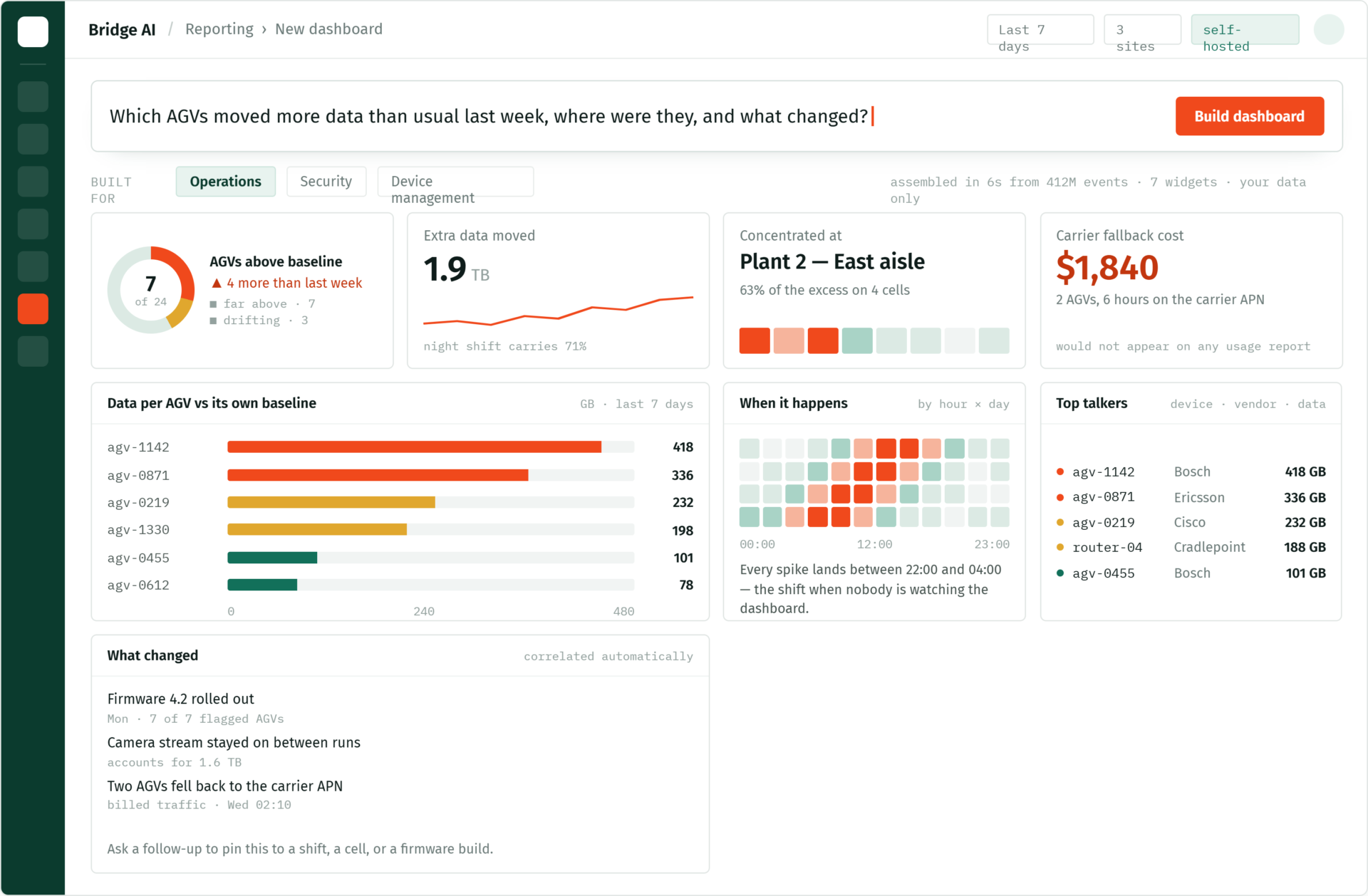
Coming Soon
INTELLIGENT REPORTING
Describe what you want to see, in plain language, and get a dashboard built on your own data, tailored to the questions your role actually asks. Security, device management, and operations stop sharing one dashboard built for none of them.
Stop translating raw telemetry manually. See what's connected, what's
drifting, and what needs action — in plain language.
FROM INSIGHT TO ACTION
OneLayer extends Zero Trust to private 5G and LTE networks through two coordinated controls: a staged onboarding environment that verifies every device before it reaches production, and device-level microsegmentation that enforces communication boundaries once they do.
The cause gets explained in plain language, not signaling codes, along with the real operational and cost impact, not just the fix.
Security, device management, and operations each get a view built around their own questions, instead of one dashboard trying to serve everyone.
Anomalies that no static rule catches get surfaced automatically, so a device drifting from its baseline gets flagged before it becomes an incident.
DATA PRIVACY
Some of OneLayer’s models are lightweight enough to run entirely on your infrastructure. There’s no requirement to send sensitive operational data to a third-party AI provider to get an answer, and no requirement for an internet connection to get one.
What Our Customers Are Saying
“One issue took us five months to get to the bottom of: pulling logs, escalating to our carrier, cross-referencing between teams to piece it together. Something that can do this in real time is the difference between five months and five minutes.”
Support covers 100+ CPE vendors out of the box, along with all major private LTE and 5G core platforms, so operators don’t need to standardize on a single router vendor first. Additional vendors can be onboarded as new equipment is introduced.
No hardware changes or agents are required — it connects directly to the private cores and CPE routers already in place. Device discovery and fingerprinting typically begin within hours of connection, and deployment is measured in days rather than months.
Once every device behind every router is identified and classified, network maps stay current automatically instead of relying on manual scans or spreadsheets that go stale. That live topology gives OT and IT teams a shared, trustworthy record to build network segmentation and enforcement decisions on, rather than guessing at what a router might be hiding.
No. OneLayer extends your existing Zero Trust architecture to cover private cellular networks, which most ZTNA tools were never designed to reach. Your current stack (NAC, MDM, ISE, SIEM) continues to operate as-is. OneLayer integrates with it, surfacing cellular connection events and policy decisions into the same workflows your security team already uses.
For unmanaged IoT and OT devices, OneLayer uses signature-based fingerprinting. A device identity is constructed from stable, device-specific attributes: IMEI, radio behavior, connection patterns, and other observable characteristics. This signature becomes the identity assertion at connection time. Certificate-based validation is used for managed endpoints that can support it.